Part 1 | How Much Can Biochar Reduce Drought Risk? A Modeling Study
Revisiting the 2024 cocoa crisis through a biochar lens
By Devin Copenhaver, Head of Market Development at Valorize
Introduction
In 2024, cocoa markets experienced one of the worst supply shocks in recent memory. Production losses across West Africa — driven by extreme weather, degraded soils, and long-standing structural vulnerabilities — pushed prices to record highs and exposed just how susceptible cocoa is to climate extremes.
While the immediate focus was on stabilizing prices and mitigating short-term losses, a deeper question remains: how can cocoa producers reduce the worst effects of the next drought?
Drought affected the entire region, but its impact was uneven, with some farms losing nearly their entire crop while others continued producing.
We modeled biochar's impact on the most vulnerable farms during the 2024 crisis. While biochar is known to improve overall yields, our focus here was specifically on reducing volatility. Our model shows that biochar mitigates value-at-risk for cocoa farms, especially on sandy soils.
Crucially, data suggests that 2024 was not an anomaly, but a harbinger. Drought risk in West African cocoa regions has been climbing for decades, and climate models project this trend will continue.
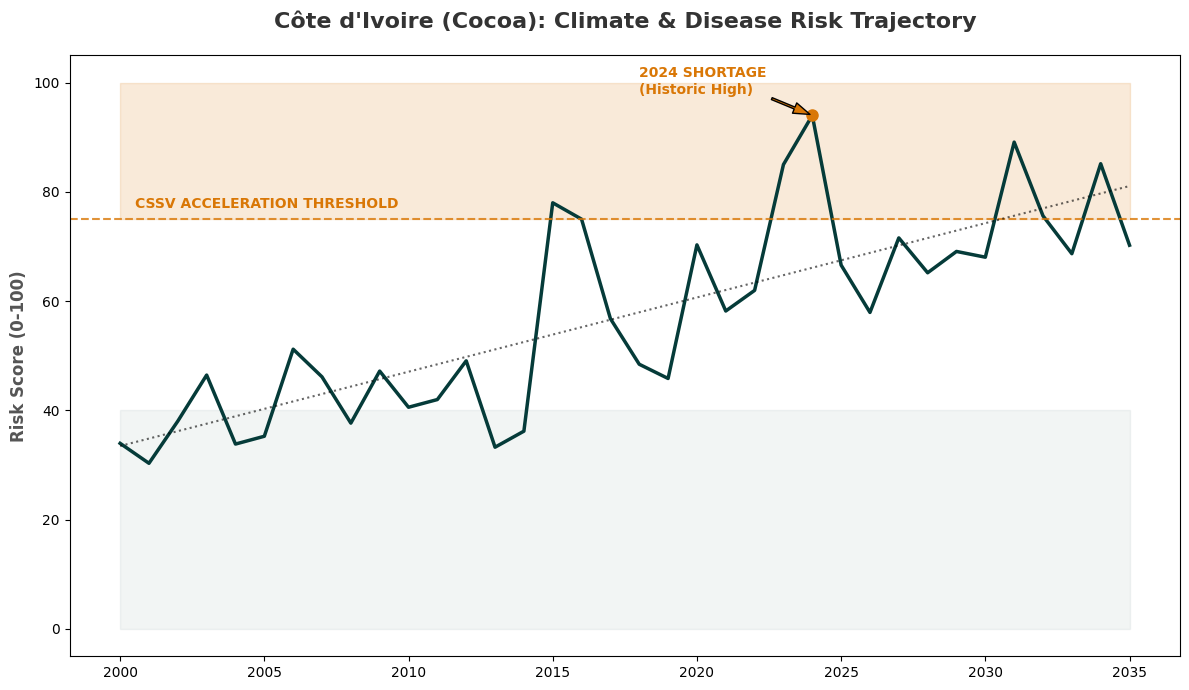
West Africa is likely to experience more frequent, more intense drought. What used to be a 1-in-10-year drought is projected to become a 1-in-3-year event by 2035.
The One-Two Punch: Waterlogging and Drought
Two weather events struck West Africa between late 2023 and early 2024.
The first was waterlogging. Between September and December 2023, the region received more than double the average rainfall, saturating the soil for weeks. This caused root stress and triggered outbreaks of Black Pod Disease. By the time the dry season arrived, cocoa trees had already been weakened.
The second was drought. In February 2024, dry Harmattan winds from the Sahara, amplified by El Niño, pushed temperatures above 32°C for extended periods. With their root systems already compromised, cocoa trees couldn't supply enough water to their leaves. On the worst-affected farms, the result was widespread crop loss.
Building Our Model for Biochar Deployment
We modeled a 12,500-hectare cacao sourcing district in Côte d'Ivoire, focusing on farms that experienced high rates of crop failure in 2024. In this scenario, biochar was deployed over a three-year period to match production capacity. Using soil type and verified rainfall/temperature data, we measured the resilience gained through strategic biochar deployment.
Our deployment parameters:
- Coverage: 12,500 hectares (farms with sandy soil only, representing an estimated 5-10% of total sourcing land)
- Volume: 50,000 tons over three years (2021–2023) at 4 tons per hectare
- Initial capital: $15M ($300/ton all-in)
- Annual maintenance: $1.2M (10% erosion top-up)
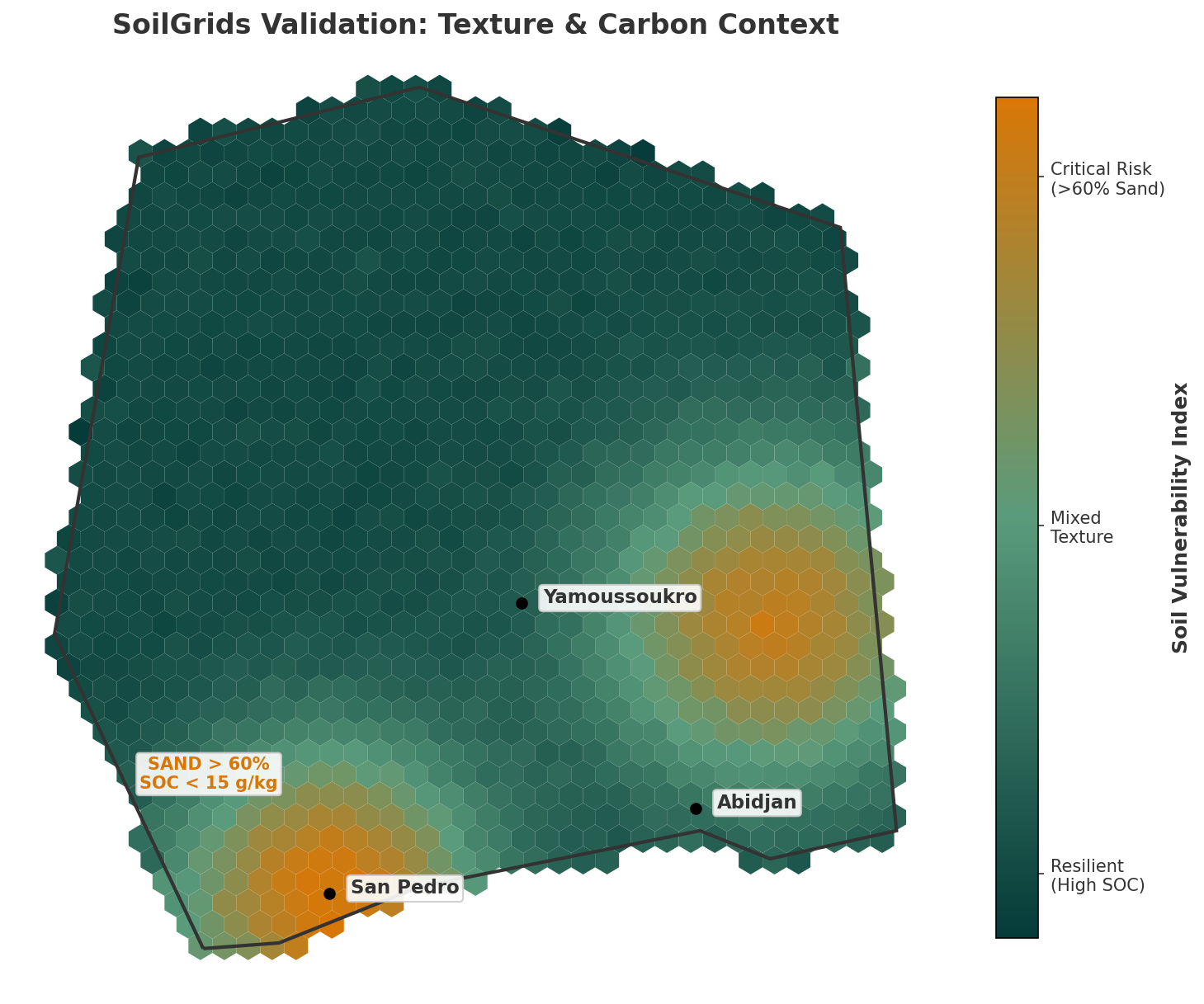
Côte d'Ivoire Soil Vulnerability Map. The sandy zones (gold) represent areas with >60% sand content and <15 g/kg Soil Organic Carbon. These districts experienced near-total crop failure in 2024, validating the correlation between soil texture and financial risk.
Model Assumptions: Conservative Parameters
Our crisis impact baseline assumes normal yields of 450 kg/ha dropping to 279 kg/ha without biochar (a 38% loss), while biochar-amended soils maintain 357 kg/ha.
This 28% effectiveness factor combines meta-analysis data showing approximately 20% base water retention improvement in sandy soils, with additional protective benefits under the extreme drought conditions specific to sandy soils. This is conservative relative to some field trial results, but appropriate for a stress-test scenario.
For tree mortality, we project 20% loss from combined waterlogging-drought stress without biochar, versus 2% with biochar. These estimates are based on biochar's protective properties: improved drainage during waterlogging, and water retention during drought.
We price the crisis at $8,000/MT for modeling purposes, though December 2024 peaks exceeded $12,646/MT verified by ICE Futures. Replanting costs run $3,600/ha based on industry estimates, which include both the trees themselves and the four-year revenue loss while new trees mature.
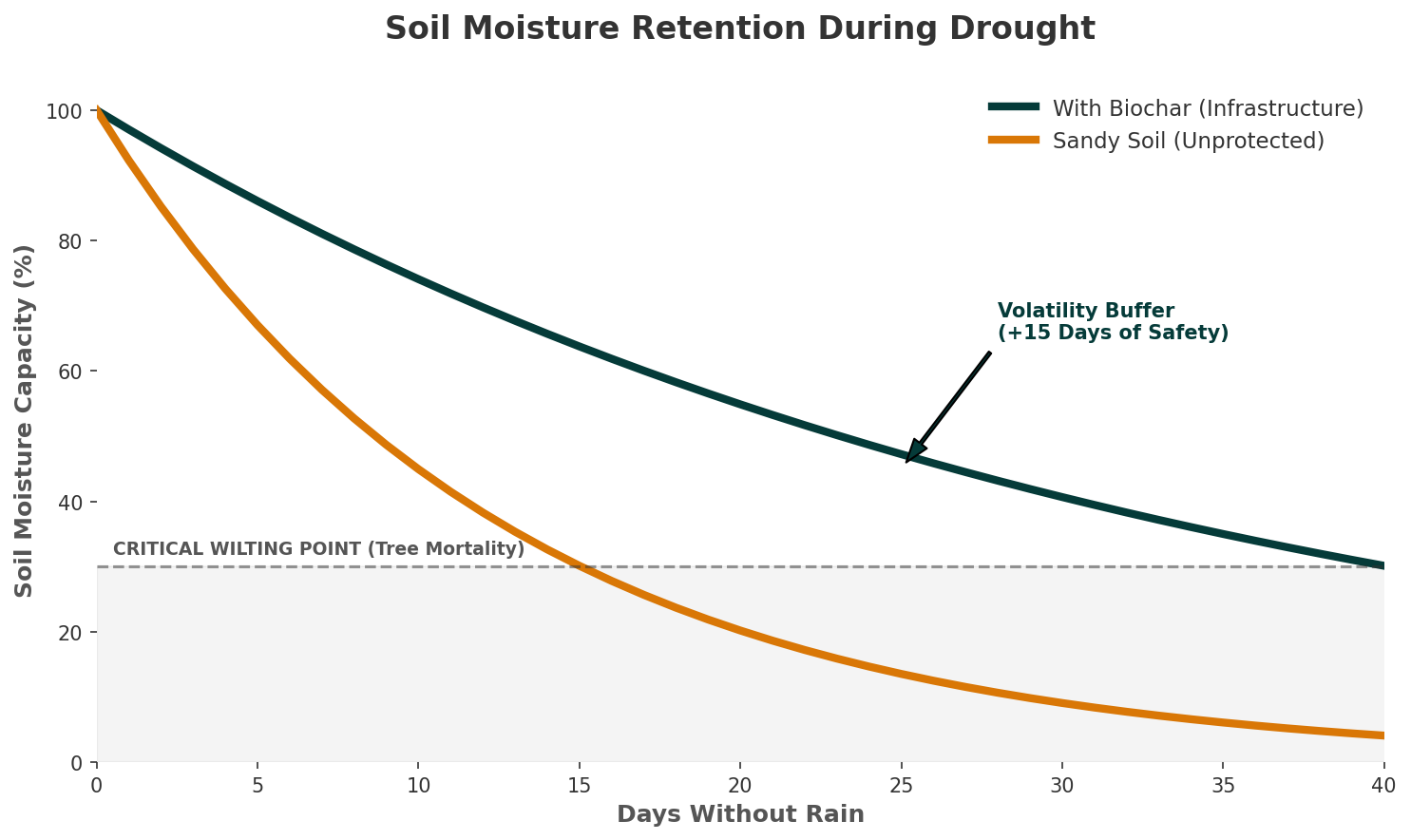
Sandy soil vs. biochar-amended soil: Biochar maintains critical moisture levels during drought stress, preventing crop loss. The orange line shows sandy soil dropping to critical failure by day 33; the blue line shows biochar-amended soil retaining moisture for longer.
The Results
Our findings suggest significant protection value. In a single crisis season, 50,000 tons of applied biochar could have generated $13.8M in value, recovering 92% of the initial 3-year capital investment.
What was protected:
- Yield: 357 kg/ha maintained (vs. 279 kg/ha without biochar)
- Volume: 600 tonnes of harvest across 12,500 hectares
- Trees: ~2.5 million cocoa trees saved from drought mortality
Financial impact:
- Harvest revenue: $4.8M (600 tonnes @ $8,000/t)
- Avoided replanting: $9.0M (~2.5M trees × $3.60/tree)
- Total value: $13.8M
The protected volume of 600 tonnes reflects the net harvest impact after accounting for reduced tree mortality (20% loss avoided, preserving effective producing area) and the conservative 28% effectiveness factor applied across the 12,500 ha of sandy-soil coverage.
Return on investment:
- One crisis season covered 92% of the $15M deployment cost
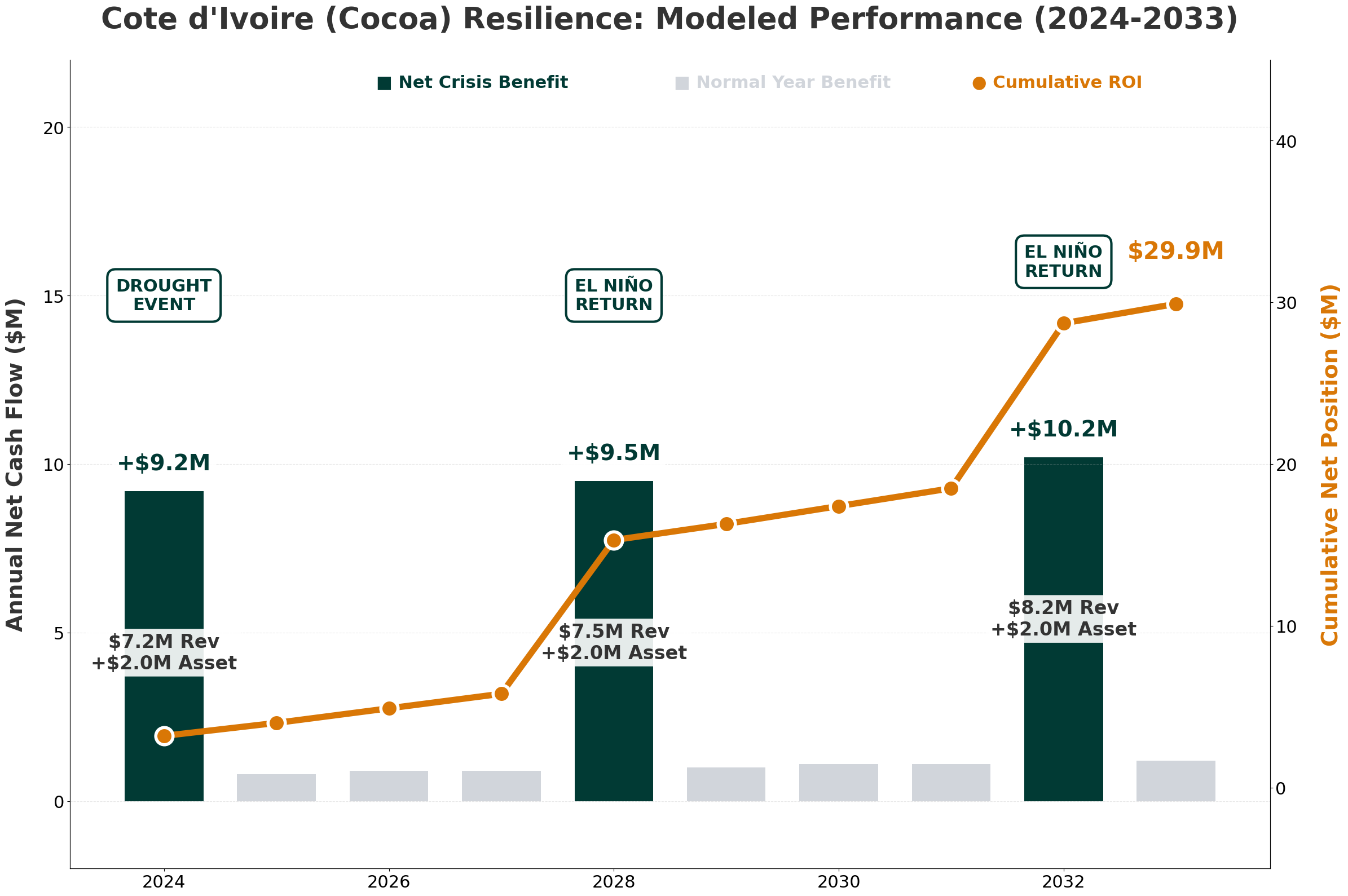
Because biochar protects yields that would have otherwise failed, a single crisis-year payout (approximately $13M) covers an entire decade of maintenance. The cumulative ROI (dark line) remains positive despite annual carrying costs.
Key Model Limitations & Assumptions
This analysis is an original modeling study based on regional averages, historical data, and meta-analyses—it is illustrative and representative, not prescriptive for any specific farm or supply chain.
- Assumes uniform biochar application and consistent soil response across covered hectares; real results vary by local soil conditions, management practices, biochar quality/feedstock, and application rates.
- Focuses solely on drought-protection value in crisis years; excludes potential normal-year yield improvements from nutrient retention, reduced irrigation needs, or long-term soil health gains.
- Crisis recurrence (~every 4 years) is based on observed El Niño patterns; actual drought timing, severity, and frequency are variable and influenced by climate change.
- Tree mortality and yield impacts use conservative estimates derived from mechanisms and literature; field validation on large commercial scales is recommended.
- All figures (ROI, protected value) are directionally indicative and site-specific—contact us for tailored simulations.
Biochar as Yield Protection
Biochar economics work like insurance, not fertilizer. Biochar doesn't boost yields in normal years, it prevents collapse in crisis years. Figure 5 shows this protection in action across a 10-year cycle.
During normal years (2025-2027, 2029-2031), farms with and without biochar perform similarly at the baseline of 450 kg/ha. But during crisis years (2024, 2028, 2032), the difference is stark. Unprotected farms drop to 279 kg/ha, while biochar-amended farms maintain 357 kg/ha, saving 78 kg/ha per crisis.
This "saved yield" provides the liquidity farms need to stay solvent during shocks. It's the difference between recovering and going under.
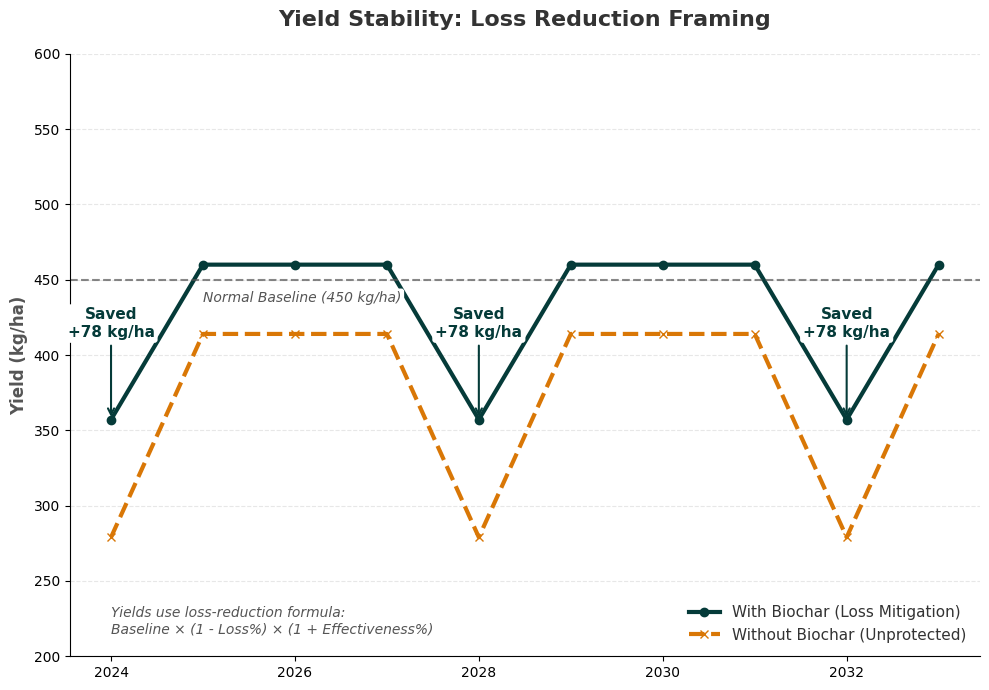
Yield Stability: Biochar maintains production during crisis years when unprotected farms collapse. The pattern repeats with each drought cycle
Stress Testing the Model
We designed this model with conservative assumptions. The 10% annual erosion rate means replacing the entire asset over 10 years through maintenance. Even under this cost burden, Year 1 net returns of $13.8M cover 92% of the initial capital investment.
Our yield assumptions are also conservative. We modelled 357 kg/ha with biochar protection during crisis conditions (well below the 600+ kg/ha that well-managed West African farms achieve under normal conditions). Our model assumes biochar brings cocoa trees to the lower end of typical performance, not optimal performance.
Conclusion
Our findings support biochar's role in drought resilience. Our counterfactual model shows how vulnerable farms would have performed with biochar during the 2024 crisis, and the impact is significant. On the hardest-hit farms, biochar could have significantly reduced crop losses.
Without soil infrastructure, crisis years like 2024 will likely become more common.
Next Steps
If you source cocoa from West Africa's sandy zones or manage supply chains exposed to climate volatility, this model may be relevant to your portfolio.
We can help you:
- Run supply chain risk simulations for your specific sourcing districts
- Model farm-level and zone-level deployment scenarios using your actual sourcing data
- Develop implementation strategies, whether through local production partnerships or fostering distributed supply
- Quantify the potential hedge value for your portfolio before the next crisis
Contact us to discuss how biochar infrastructure could help stabilize your supply chain.
Does This Model Apply to Coffee?
Yes. The same soil physics apply to coffee, but the economics differ.
In Part 2, we model coffee's response to the 2024 El Niño in Vietnam and Brazil. The results show roughly double cocoa's returns over 10 years.
Read Part 2 to see how biochar can protect coffee supply chains before the next El Niño event.
APPENDIX: Modeling Methodology (Cocoa Systems)
For those who want to see under the hood: full model assumptions, data sources, and calculations.
Model Parameters
- Crisis pricing (December 2024 verified): Cocoa: $8,000/MT (conservative estimate; peaks exceeded $12,900/MT on Dec 18, 2024)
- Asset replacement cost: $3,600/ha (replanting + 4-year revenue loss)
Operational Assumptions
- Biochar deployment: 50,000 tons over 3 years (2021-2023)
- All-in cost: $300/ton (production, logistics, application)
- Application rate: 4 tons/ha
- Coverage: 12,500 hectares (red zones only)
- Total CAPEX: $15M
- Annual maintenance: $1.2M (10% top-up replacement)
Tree Survival Estimates
- No biochar: 80% survival (20% mortality from combined waterlogging and drought stress)
- With biochar: 98% survival (2% mortality)
- Note: These are model estimates based on biochar's known protective mechanisms, not field survey data
Erosion Assumption:
- Estimated 10% annual biochar loss requiring top-up applications. This is a conservative planning assumption for tropical conditions.
Yield Benchmarks
- Crisis scenario (2024):
- Baseline yield (normal conditions): 450 kg/ha
- Without biochar: 279 kg/ha (38% drought loss)
- With biochar: 357 kg/ha (28% of loss recovered)
- Saved: +78 kg/ha
- Total impact across 12,500 ha:
- Protected volume: ~600 tonnes
- Revenue protected: $4.8M (600t × $8,000/t)
- Asset preservation: $9M (prevented replanting costs)
- Effectiveness:
- The 28% effectiveness factor reflects site-specific conditions: base water retention benefit (15%), sandy soil bonus (10%), and extreme drought bonus (3%).
Key References
- Edeh, I.G., Mašek, O., & Buss, W. (2020). A meta-analysis on biochar's effects on soil water properties. Science of The Total Environment, 714, 136857.
- Energy and Climate Intelligence Unit (ECIU). (2024). El Niño, climate change and UK food supply.
- Harvard Salata Institute. (2024). Chocolate's climate crisis. Analysis showing 68% of yield variation explained by rainfall extremes.
- International Cocoa Organization (ICCO). (2024). Quarterly Bulletin of Cocoa Statistics.
- Lehmann, J., & Joseph, S. (2015). Biochar for environmental management: Science, technology and implementation. Routledge.
- Li, Y., et al. (2021). Role of biochar in improving sandy soil water retention. Water, 13, 407.
- Wei, L., et al. (2023). Drivers of biochar-mediated improvement of soil water retention capacity based on soil texture: A meta-analysis. Geoderma, 437, 116599.
- World Weather Attribution. (2024). Climate change made West Africa heatwave 10 times more likely.